
Sunday, December 11, 2011
Lunar Eclipse
This past weekend we (as in all of us on Earth) were treated to a lunar eclipse. At least those of you who lived in a non-cloud infested city were. The eclipse started at about 4:45 am and ended about 6:30 am in Vancouver. Unfortunately from the vantage point I chose I only got to watch it for about 25 minutes before clouds rolled in a covered the entire sky. Its actually doubly sad because this is the last lunar eclipse until sometime in 2014.
 Despite the poor seeing conditions I did manage to see about 1/4 of the eclipse and I'm thankful for that. I set up my telescope and camera in Terra Nova park in Richmond. I was planning on taking a nice mosaic of the eclipse at different times but this was thwarted by the clouds. And my poor choice of cameras. Out of haste I grabbed my modified T3i which has the IR filter removed. The result is a noticeable reddening of the moon even though it should be a nice off white until totality (which I missed). Anyway since I missed the majority of the eclipse I've only included one of the unedited pics I took just after the eclipse started. Enjoy!

Friday, December 2, 2011
Second take at Orion
Orion Nebula, Year 2.
Last year when I seriously started astrophotography the Orion nebula was my first real target. Its bright. Its easy to find. And it looks really cool. However its also really hard to get a decent image of. Mostly because the stars that make up the Trapezium (the bright central part) overwhelm the more diffuse, dim outer layers. This was my second attempt, and due to a malfunctioning autoguider, shifting tripod and really cold temperatures it was limited to about fifteen 30 second unguided exposures. Still, its worlds better then last years shots. I've put the two shots side by side for easy comparison.


Sunday, September 4, 2011
Fall Astronomy
With the start of September I guess its fair to say that fall has begun. Ironically the weather is more like what should be expected in the middle of July. Warm, clear days with nights perfect for stargazing. Ironically I have to go back to work in a few days and my stargazing nights will be mostly limited to weekends. However this past weekend I did my best to get out and enjoy the wonderful fall sky; over two nights I spend more than 10 hours staring up at the stars. I've also decided that I really should replace my LVI autoguider. There are definitely better, more user friendly autoguiders out there. So that will be my next major purchase. This realization came while I was trying to image the Pelican nebula (below).

 Its a bit difficult to really make out. The nebula didn't turn out quite as well as I had hoped, particularly in comparison to the North America Nebula which is right next to it (and something I imaged when I was in Merritt). Despite the fact that this was nearly an hours worth of images I'm guessing that because the Pelican Nebula is mostly HAII my unmodified camera wasn't able to really gather all the light that it should have. That and because this was taken from Mount Seymour and not and dark sky site like Merritt.
In addition to this photo I also took some time to shoot the Eskimo Cluster (NGC 457) and another nearby small cluster. These ones aren't quite as well suited to a wide field scope like my TV85 but they still turned out reasonably well. Still they turned out alright. I guess if you use your imagination you can see why the cluster was given the nickname of the ET cluster.

Tuesday, August 30, 2011
Merritt Star Quest

Last weekend I spent three days at the Merritt StarQuest. The weather and skies were absolutely beautiful! Luckily I brought enough clothes because I wasn't really expecting the huge temperature swing that we had. During the day the high was around 35 degrees but by 2:30 am the temperature was down around 5 degrees. Asides from the night time lows, the skies were brilliant. The Milky Way was so bright it was often a distraction from the rest of the sky. I can't wait until next year! Hopefully the weather will allow for more nights of stargazing!
The first night was largely used in polar aligning my telescope, setting up my autoguider and in general getting ready to observe. I was quite frustrated with my autoguider, which I'm now planning on replacing. Fortunately a friend of mine had an extra autoguider that I was able to test out which worked quite well. After much cursing and frustration I finally managed to get a few decent pictures.
 This is a composite of 4 five minute shots of the milky way taken with an 18 mm lens on my Canon rebel xTi. In order to avoid star trailing the camera was mounted on my HEQ5 tracking mount.
North America Nebula
 This is 8 five minute exposures through a TV85 taken with a Rebel xti.
Pleiades

3 five minute images through my TV85 with a Rebel xTi
Friday, August 5, 2011
More summer astrophotography
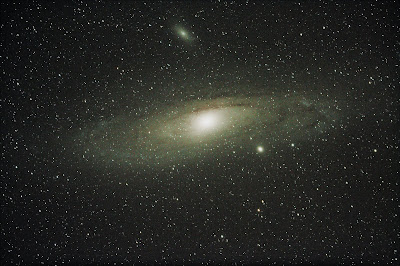
Since the beautiful west coast weather continues so to do the opportunities to take pictures. The latest include a few more shots of Andromeda and the Whirlpool Galaxy as well as a new target: the North American Nebula. I think I've finally got my autoguider working correctly and so far am reasonably pleased with how its going. Hopefully I'll have one more opportunity before I leave for Spain!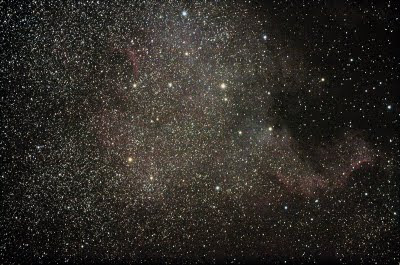


Saturday, July 30, 2011
Galaxies, Clusters and Nebulas

In the past 6 weeks I've done more stargazing than I have in the past 6 months. This includes 3 or 4 all night sessions on Mount Seymour and a few nights in the park across from our condo. The photography is fun, but very demanding. Even though it can take an hour to get one good picture, being able to look at what I've accomplished is definitely worth all the cold nights.
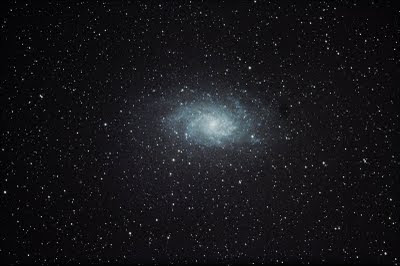
The latest photos, taken July 29th include a nice shot of the Triangulum Galaxy and the Pleiades. I'm especially pleased with the Pleiades mostly because I also captured the reflection nebula around it.
The latest photos, taken July 29th include a nice shot of the Triangulum Galaxy and the Pleiades. I'm especially pleased with the Pleiades mostly because I also captured the reflection nebula around it.

Thursday, July 28, 2011
A few more summer pics
I'm taking full advantage of the nice weather I've finally been given. After months and months of cloud and rain its finally summer and warm in  Vancouver. So over the last month I've spent many hours staring at the stars and the little LCD display on my DSLR. All that work has resulted in the following two pictures (actually there are about half a dozen more but they didn't turn out particularly well). I'm slowing getting the focusing issue under control at least with the my refractor (the SCT is still a pain to deal with photographically speaking). Anyway these pictures are of the Dumbell Ne
 bula (look to a previous post if you want to compare it to my first image of the Dumbell Nebula.)
The second image is of the Ring Nebula. Its a very small, bright planetary nebula. This picture (like most of the images) was taken through my 85 mm refractor and I think the next time I decide to image the Ring Nebula I'll try it with my 8" SCT. Its such a small target that the extra magnification should make a bug difference.
 Vancouver. So over the last month I've spent many hours staring at the stars and the little LCD display on my DSLR. All that work has resulted in the following two pictures (actually there are about half a dozen more but they didn't turn out particularly well). I'm slowing getting the focusing issue under control at least with the my refractor (the SCT is still a pain to deal with photographically speaking). Anyway these pictures are of the Dumbell Ne
 bula (look to a previous post if you want to compare it to my first image of the Dumbell Nebula.)
The second image is of the Ring Nebula. Its a very small, bright planetary nebula. This picture (like most of the images) was taken through my 85 mm refractor and I think the next time I decide to image the Ring Nebula I'll try it with my 8" SCT. Its such a small target that the extra magnification should make a bug difference.
Subscribe to:
Posts (Atom)