As of June 2nd it looks like summer has 'officially' begun in Vancouver. The weather has finally improved and the skies are clear enough to do some decent stargazing. The only downside is that because summer has started so late the skies don't darken until around midnight. But nevermind that. This past weekend I spent two nights and a total of close to 8 hours st

argazing on Mount Seymour. I spent most of the time trying to work out how to use my new autoguider which has been sitting in storage for nearly 4 months since I bought it. Turns out that its quite easy to use, although I'll have to see if the set up I have will really work with it.
With the help of a friend, Chris Ho, I also attached a laser pointer to the rings of my refractor (on the left side of the telescope in the pictures). Unfortunately the batteries get really cold and it doesn't work very well. I'm going to have to see if there is another way around this problem; I'll think of something I'm sure.
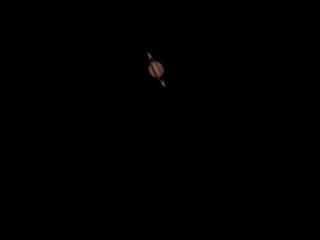
So like I said, this past weekend I spent quite a bit of time stargazing. On Friday night it was mostly an inauguration of the new telescope and then testing out my autoguider. On Saturday I set up to do some imaging and despite some thin, high clouds I was rewarded with two decent photos. The first was of Saturn, and although its not bad, I'm not satisfied. Hopefully I'll get a few more opportunities before the summer. This particular photo was shot with a Celestron NexImage through a Celestron 8" SCT. The image was 1000 frames stacked in Registack.
The other picture was of M13, the Hercules Cluster. Focusing was a bit of a bugger, mostly tons of trial and error. Fortunately my new motor focuser should be arriving someti
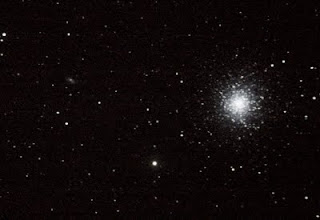
me in the next couple of weeks. Hopefully the postal strike doesn't get in the way. Anyway, I was using my canon 400D and stacked 5 images of 90 seconds each. I didn't do a particularly good polar alignment (at least as far as photography goes) and with the 3 minute exposures I tried I was beginning to see some trailing so I opted for the shorter exposures in the end. Plus, it meant less waiting and at 2:30 am I was getting cold and tired. After I stacked the pictures I noticed a very unexpected result. Looking closely at the middle left there was a slight smudge that at first I thought was just the result of imperfect focusing. After checking with a star atlas I realised that not only did I photograph M13 but I also managed to capture NGC 6207, a spiral galaxy about 30 million light years away.
So with my first real star cluster successfully photographed I just can't wait to get out and do some more stargazing! Hopefully the weather cooperates.


 Vancouver. So over the last month I've spent many hours staring at the stars and the little LCD display on my DSLR. All that work has resulted in the following two pictures (actually there are about half a dozen more but they didn't turn out particularly well). I'm slowing getting the focusing issue under control at least with the my refractor (the SCT is still a pain to deal with photographically speaking). Anyway these pictures are of the Dumbell Ne
 bula (look to a previous post if you want to compare it to my first image of the Dumbell Nebula.)

 I managed to more or less accomplish most of my goals. Focusing was acceptable on the TV-85. Not perfect, to do that I suspect I'll need a motor-focuser (and a camera with live view so I can properly use my Bahtinov mask). The maximum time I could track for without trailing becoming too noticible was just under 3 minutes. Both of these resulted in some nice deep sky pictures. I still have higher expectations but it was a good start.

 een doing my best to get out and take some shots of Saturn. The latest pictures were about 5 minute movies that I shot with a Phillips webcam and stacked together. They turned out reasonably well, but I'm hampered by the relatively small size of the chip in the webcam. I have another idea that I'm going to try (hopefully tomorrow) which is to use a point and shoot camera and try some afocal shots.
 argazing on Mount Seymour. I spent most of the time trying to work out how to use my new autoguider which has been sitting in storage for nearly 4 months since I bought it. Turns out that its quite easy to use, although I'll have to see if the set up I have will really work with it.
 me in the next couple of weeks. Hopefully the postal strike doesn't get in the way. Anyway, I was using my canon 400D and stacked 5 images of 90 seconds each. I didn't do a particularly good polar alignment (at least as far as photography goes) and with the 3 minute exposures I tried I was beginning to see some trailing so I opted for the shorter exposures in the end. Plus, it meant less waiting and at 2:30 am I was getting cold and tired. After I stacked the pictures I noticed a very unexpected result. Looking closely at the middle left there was a slight smudge that at first I thought was just the result of imperfect focusing. After checking with a star atlas I realised that not only did I photograph M13 but I also managed to capture NGC 6207, a spiral galaxy about 30 million light years away.